The rooms that actually sell homes
Executive summary

Property is a value-driven decision, but the way it’s assessed is outdated and reduced to a handful of structural metrics such as bedrooms, bathrooms, car spaces and land size. Those details matter to qualify a home but they don’t explain what people are actually looking at and engaging with when they decide whether it will work day to day and if the price makes sense.
At Little Hinges we sit in the middle of that decision-making. Everyday buyers and renters use our virtual inspections to explore homes remotely. They move through spaces, double back and spend time where uncertainty shows up or value is being tested Over time those millions of inspection journeys create something the industry has never had access to: a behavioural dataset that shows how homes are evaluated in practice, not just how they are marketed.
This white paper shares insights drawn from more than 12 million Little Hinges virtual inspections across Australia revealing how attention concentrates across a home which spaces people return to and how inspection patterns shift across states and price points.
The aim of this report is to help homeowners, agents, developers and investors better understand what drives perceived value when people are walking through a home
digitally and apply that insight to presentation decisions, design and renovation priorities, product mix and how value is communicated to the market.
Thank you to the teams, partners and property professionals who make these inspections possible and to the Little Hinges team behind the platform and data that sits underneath them. The more we understand real behaviour the better we can design, present and price homes in ways that match what people actually value.
Josh Callaghan
CEO, Little Hinges
Introduction
Property value has traditionally been communicated through simple structural measures such as bedroom count, bathroom count and parking spaces. While these attributes are important they offer a limited view and provide no insight into how people actually assess a home, the describe at a high level what a property contains but not how it is experienced. Behavioural evidence shows that once a property has been qualified by room count, perceived value is shaped by how spaces function connect and support real use.
Our virtual inspection platform captures how buyers and renters engage with a property during an online inspection. This data provides a direct lens into behaviour, enabling detailed analysis of dwell time, movement, and re-entry patterns, showing how people navigate homes and which spaces shape perceived value. Virtual inspections move beyond stated intent and capture real decision-making patterns as they occur.
This analysis draws on behaviour observed across more than 12 million virtual inspections facilitated through Little Hinges.
Drawing from over 10,000 Australian residential virtual tours, our property-level dataset has been cleaned and standardised at the room level to ensure comparability across rooms, states and property values. This allows us to look beyond overall traffic and understand where attention concentrates, how often people re-enter key spaces and how movement patterns change across price tiers and states.
Together these behavioural signals reveal that attention is not distributed evenly throughout the home. Certain rooms and spatial layouts attract deeper engagement and repeated visits from people, indicating they play a greater role in shaping how a property’s value is evaluated.
The findings that follow set out which spaces matter most. They also show how their influence changes with property value and where behaviour varies across markets.
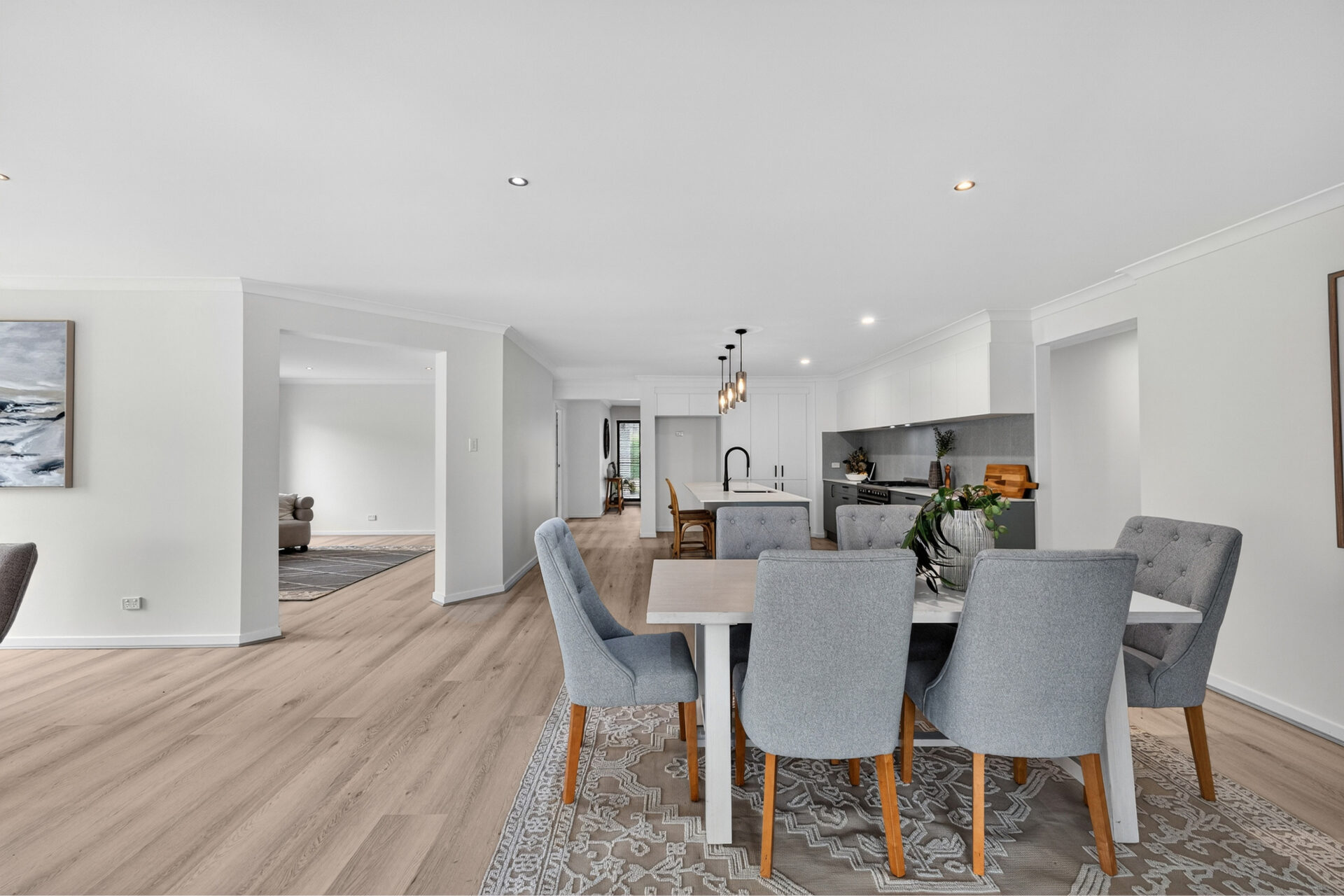
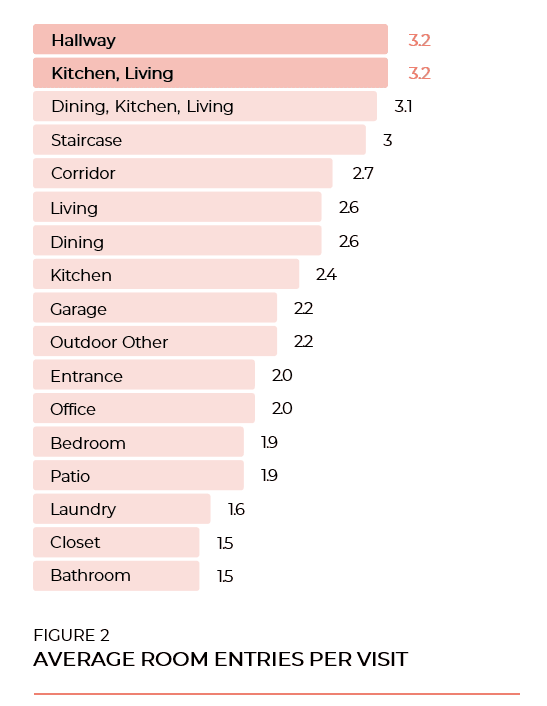
On average, open-plan living, kitchen and dining areas record dwell times of 65.2 seconds per visit and have higher re-entry rates, averaging 3.1 entries per user.
The living-kitchen core is the primary driver of perceived value
Kitchens and living rooms lead all room types in attracting the most visitors and longest visits across virtual inspections.
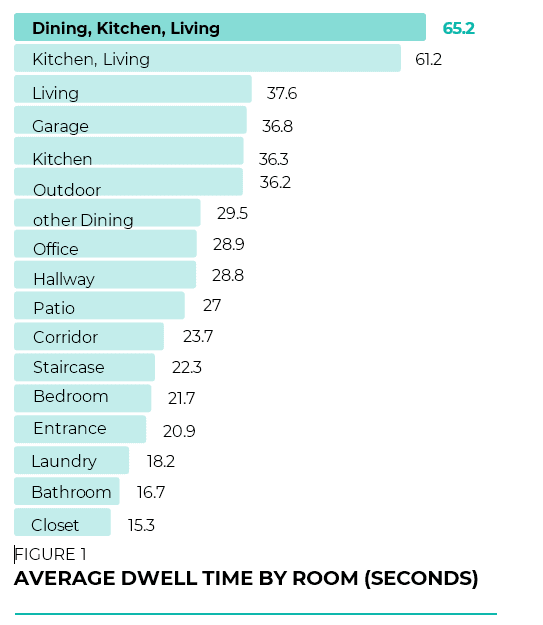
Visitors explore standalone kitchens close to twice as long as other rooms types, with
average dwell times of 36.3 seconds per visit. Likewise, visitors spend close to double the amount of time in standalone living rooms, averaging 37.6 seconds per visit. By comparison, the average dwell time across all other rooms throughout the house is 21 seconds per visit.
People inspecting homes digitally spend significantly more time evaluating these rooms, which shape daily living routines and are defined by their finishes and usability. This extended engagement reflects the fact that kitchens and primary living spaces are among the most costly and complex areas to modify, with fixed layouts, built-in cabinetry and integrated appliances.
As a result, buyers and renters use these rooms as primary reference points when judging whether a home will function day to day. When these spaces are combined into an open-plan layout, engagement increases further. On average, open-plan living, kitchen and dining areas record dwell times of 65.2 seconds per visit and have higher re-entry rates, averaging 3.1 entries per user. This is substantially higher than standalone living rooms and kitchens, which average 2.6 and 2.4 entries per user respectively.
By comparison, most other rooms in the home record fewer than 2 entries per user on average. The increase in both dwell time and re-entry indicates a more deliberate evaluation of these areas. People are assessing how the connected spaces relate to one another, treating them as a single functional zone rather than as separate rooms.
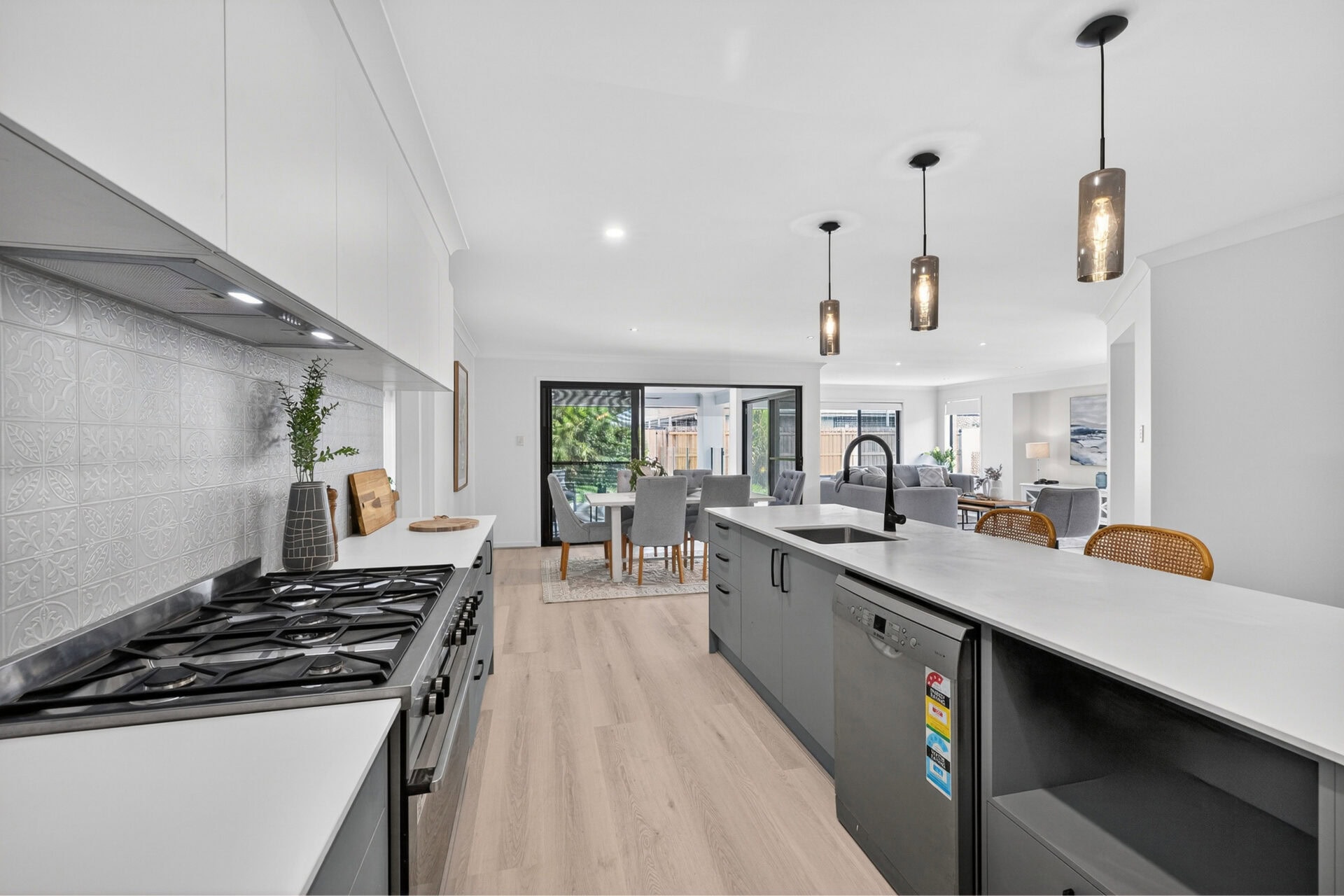
A similar pattern is observed again when a dining area is added to an open plan living and kitchen space. Open plan living, kitchen and dining areas record dwell times of 65.2 seconds per visit and average 3.1 entries per user. By contrast, detached dining rooms record shorter dwell times of 29. 5 seconds per visit and average 2.6 entries per user, aligning more closely with standalone living and kitchen rooms than with open-plan spaces.
Bedrooms and bathrooms are functional checkpoints, not value-defining spaces
Bedrooms and bathrooms remain essential. Viewers confirm they meet expectations, but behavioural patterns show these rooms usually operate as hygiene-factor checkpoints, not primary value anchors. They are assessed quickly to confirm they meet expectations, rather than explored in depth.
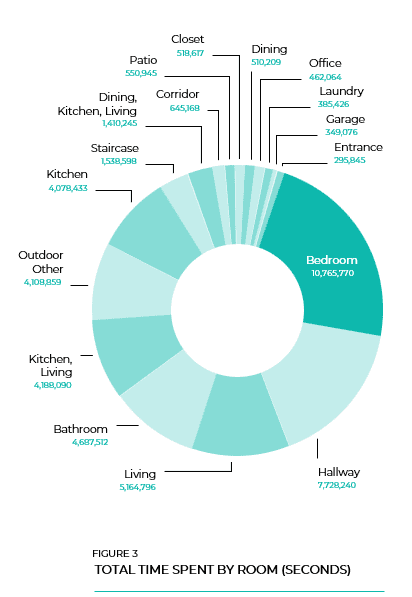
Bedrooms account for the highest share of total time spent in virtual inspections, largely because people visit multiple bedrooms within a single home. However, average dwell time per room entry remains comparatively low. Bedrooms record an average dwell time of 21.7 seconds per entry, indicating that buyers and renters are confirming size and placement rather than conducting a detailed inspection.

Bathrooms and laundries show even shorter engagement, recording average dwell times of 16.7 and 18.2 seconds per entry respectively. Again, suggesting quick checks rather than a thorough examination. This shorter dwell time indicates people are confirming key functional details such as fixtures, finishes and layout before moving on.
This pattern is reinforced by re-entry behaviour. Bedrooms average 1.9 entries per user, while bathrooms and laundries average 1.5 and 1.6 entries per user respectively, all below the overall average of 2.2 entries per user across all rooms. This shows visits occur primarily as part of linear walkthroughs rather than repeated or in-depth assessments.
Attention to bedrooms and bathrooms also remains relatively stable across property value tiers. Average dwell times do not increase meaningfully in higher-value homes, indicating that while these rooms are essential qualifiers, additional inspection does not significantly change judgement.
Together, this behaviour shows that bedrooms and bathrooms serve as baseline checkpoints in the inspection process: they must meet expectations, but they are not the spaces people rely on to interpret the rest of the home or refine their perception of value.
Entrances and circulation spaces shape perceived quality more than most rooms
One of the strongest and most practical behavioural signals emerges from spaces that are often treated as “background” in property storytelling: entrances, hallways and circulation paths.

Hallways account for a substantial share of inspection time and record some of the highest re-entry rates in the dataset, accounting for 16% of total inspection time, a higher share than any individual bedroom bathroom or utility space.
They record an average dwell time of 28.8 seconds per visit, compared with the 21-second average across all other rooms. This shows visits occur primarily as part of linear walkthroughs rather than repeated or in-depth assessments. High re-entry suggests buyers and renters repeatedly use circulation to reorient, understand layout and interpret relationships between key zones.
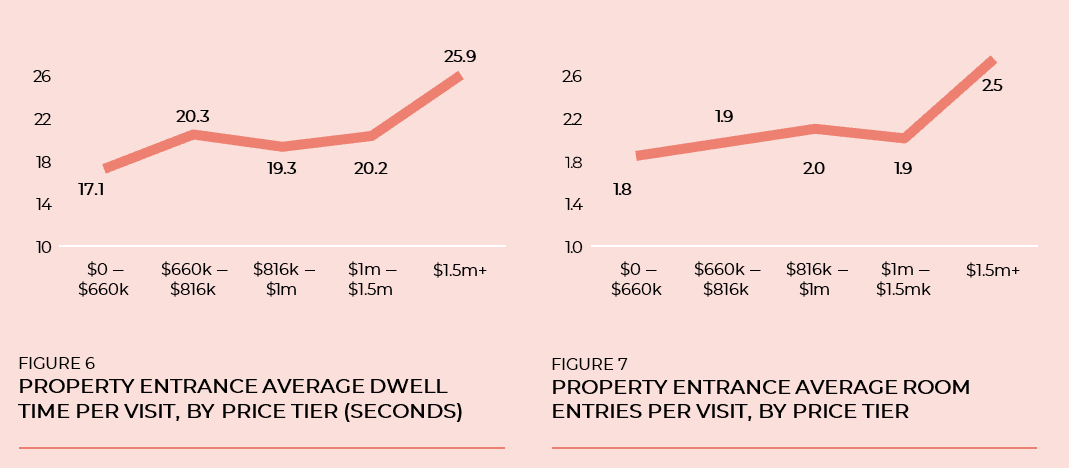
A similar effect appears at the point of entry. Engagement at property entrances rises with property price, indicating that higher-value homes prompt more deliberate inspection at the point of entry. In the first $0-$660k tier, entrance dwell time averages 17.1 seconds per visit, with re-entry at 1.8 entries per user. In the $1.5m+ tier, entrance dwell increases to
25.9 seconds per visit and re-entry rises to 2.5 entries per user.
This suggests buyers and renters devote more time to the arrival sequence, perceived quality signals and the psychological “first impression” of scale and finish. This is not purely aesthetic. It is often tied to how the entrance connects to the rest of the home and whether the layout supports the experience people expect at that price point.

Garages and offices are emerging premium differentiators
After buyers and renters assess the main living areas and use circulation spaces to understand layout, attention shifts to rooms that signal utility, flexibility and lifestyle. Garages and home offices attract sustained engagement in virtual inspections, and this engagement becomes more pronounced as expectations increase.
Garages record meaningful inspection time relative to many internal rooms. On average, people spend 36.8 seconds per visit inspecting a garage, placing it above baseline dwell times and signalling deliberate evaluation rather than a quick visual check. This level of engagement indicates that garages are not treated as incidental storage spaces, but as functional areas that contribute to overall usability.

This matters because garage space is rarely highlighted as a primary value driver, yet behavioural patterns show buyers and renters devote time to assessing access, layout, storage capacity and flexibility. Rather than simply confirming presence, inspection behaviour suggests people are evaluating how the garage supports everyday use and longer-term needs.
Home office engagement shows a clear but non-linear relationship with property value. In lower-priced homes, $660k or less, and again between $660k and $816k, average dwell time remains relatively stable at 24.0 and 23.2 seconds respectively per visit, indicating quick checks rather than detailed evaluation.
Engagement then increases in homes priced between $816k and $1 million, where average dwell time rises to 30.7 seconds per visit, reflecting increased scrutiny as dedicated workspaces become more relevant.
This pattern softens in homes priced between $1 million and $1.5 million, where average dwell time falls to 23.0 seconds per visit, before increasing sharply in homes priced above $1.5 million, where dwell time rises to 42.3 seconds per visit. At these higher price points, home offices are more likely to be purpose-built spaces, prompting deeper inspection rather than a brief visual scan.
Together, these patterns show that garages and home offices operate as emerging differentiators rather than baseline qualifiers. While they may not drive perceived value in isolation, they increasingly influence how buyers and renters assess functionality, flexibility and completeness as price expectations rise.

Outdoor areas are rising lifestyle value signals
Outdoor areas attract increasing attention as property value rises. Across the dataset, patios and outdoor zones show a clear shift in inspection behaviour in higher price tiers, indicating people spend more time evaluating how external spaces contribute to liveability and lifestyle. This pattern suggests that outdoor areas become more central to assessment as expectations around usable space increase.
Patios show a gradual but consistent increase in engagement as property value rises. In entry-level homes priced $660k or less, patio dwell time averages 22.7 seconds per visit, indicating brief checks to confirm presence and basic usability. Engagement increases through the mid-market, with dwell time rising steadily across the $660k–$816k and $816k–$1m tiers as expectations around outdoor functionality begin to shift.

In higher-value homes priced between $1m and $1.5m, patio dwell time increases to 24.8 seconds per visit, reflecting more deliberate evaluation, following a similar pattern to home offices. At this level, people are no longer simply noting the existence of an outdoor area, but assessing how it functions as an extension of internal living space. This elevated engagement remains in the $1.5m+segment, indicating that as price expectations rise, patios become a more meaningful part of overall lifestyle assessment rather than a secondary feature.
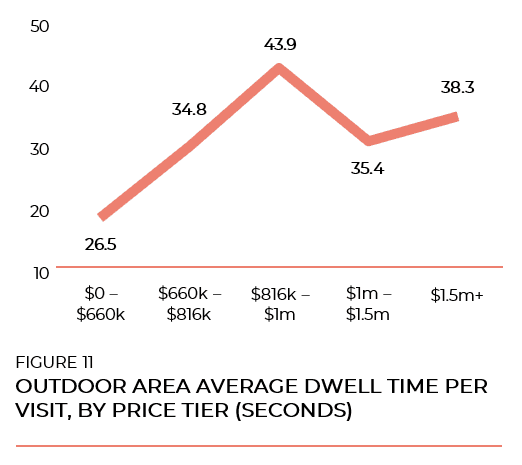
Detached outdoor areas display a stronger uplift in engagement as property value increases, though the pattern is non-linear. In entry-level homes priced $660k or less, average dwell time is 26.5 seconds per visit, rising through the $660k–$816k tier to 34.8 seconds, and peaking in the $816k–$1m range at 43.9 seconds per visit. Engagement moderates slightly in homes priced between $1m and $1.5m, where average dwell time is 35.4 seconds per visit, before remaining elevated in the $1.5m+ segment at 38.3 seconds per visit.

Overall, this sustained increase relative to lower-value homes suggests that as properties become more premium, people move beyond simply confirming the presence of outdoor space and instead spend time evaluating scale, privacy, usability and suitability for everyday living and entertaining.
Value drivers differ meaningfully across states
While the same room categories matter nationally, the emphasis varies by market context. These are best understood as consistent tendencies shaped by housing stock, climate, block sizes, density and lifestyle expectations.
In Queensland, attention concentrates more heavily on open-plan living zones, and this becomes clearer when ranking states by room-level dwell time rather than looking at absolute values alone. Queensland residents spend the least time in stand-alone kitchens of an state at 32.9 seconds per visit, and the second-least time in stand-alone living rooms at 35.3 seconds per visit, ahead of only Western Australia.
Despite this relatively low engagement with individual kitchen and living spaces, combined dining-kitchen-living areas perform strongly, sitting slightly above the national benchmark at 65.7 seconds per visit compared with the national average of 65.2 seconds per visit.
Taken together, the pattern suggests that Queensland viewers place relatively greater emphasis on how kitchen, dining, and living functions come together in an integrated space, with engagement shifting toward cohesive open-plan zones rather than being concentrated in individual rooms viewed in isolation.
In New South Wales, attention concentrates more heavily on bedrooms and circulation spaces. Bedroom dwell time averages 23.5 seconds per visit, above the national bedroom average of 21.7 seconds per visit. Relative to other states, New South Wales visitors spend the most time in bathrooms on average at 18.5 seconds per visit.
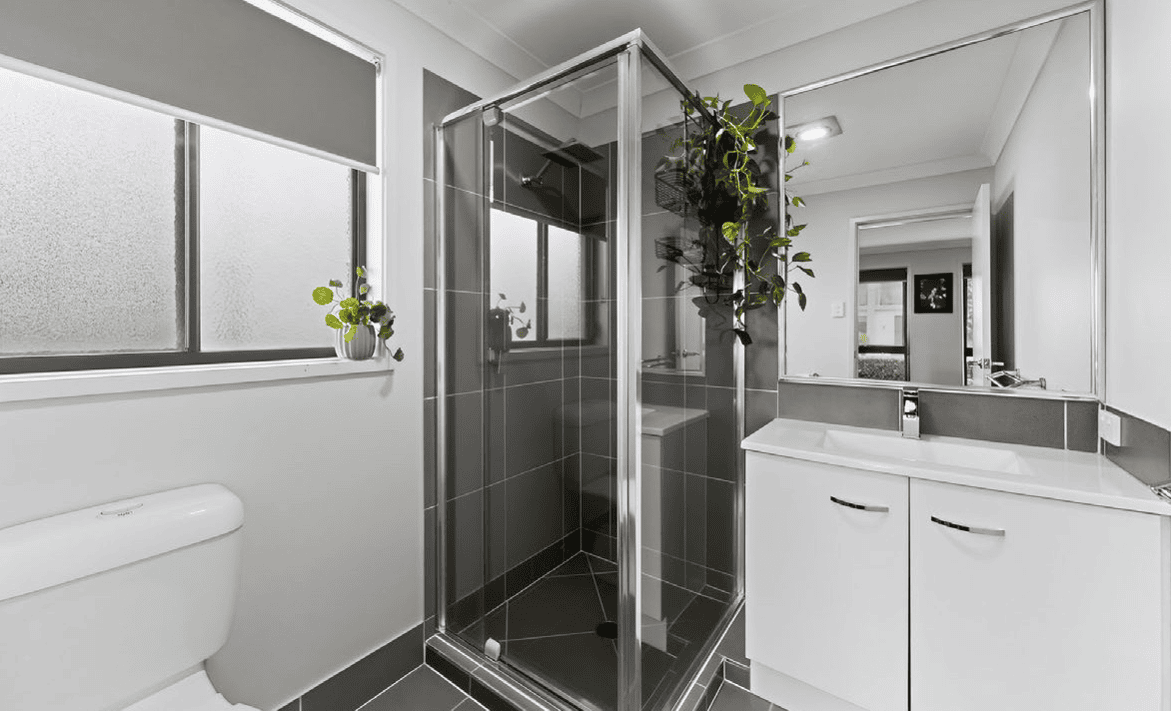
Entrances and hallways attract particularly strong attention, with entrance dwell averaging 27.0 seconds per visit compared with the national entrance average of 20.9 seconds per visit and New South Wales visitors view hallways more than any other state on average at 30.7 seconds per visit.
This behaviour reflects the prevalence of more compact or vertical housing, where buyers and renters use circulation spaces to assess layout efficiency privacy and separation between living and sleeping areas.
Victoria shows a strong emphasis on kitchens and dining spaces. Kitchen dwell time averages 39.6 seconds per visit, above the national average of 36.3 seconds per visit and dining spaces average 31.5 seconds per visit, above the national dining average of 29.5 seconds per visit. Open plan dining kitchen living areas record the longest dwell times nationally at approximately 77.1 seconds per visit, well above the national average of 65.2 seconds per visit, indicating heightened evaluation of social and entertaining spaces.
In Western Australia, behaviour is more focused and efficient, with shorter dwell times across many rooms but clear standouts in key areas. Kitchens record an average dwell time of 34.6 seconds per visit, closely aligned with the national kitchen average. Patios attract some of the highest engagement nationally at 30.3 seconds per visit compared with the national patio average of 27.0 seconds per visit.
West Australians spend an average of 13.8 seconds per visit in bathrooms compared with the national average of 16.7 seconds per visit. This below average dwell time suggests bathrooms are often treated as a rapid check rather than a focus area, reinforcing the importance of immediate visual clarity and condition signalling.
Conclusion
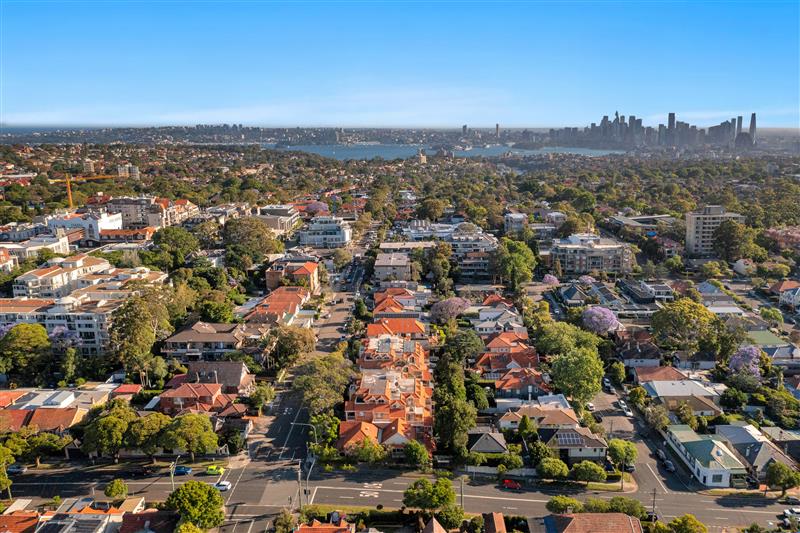
Together, these patterns show that while the same categories of rooms influence evaluation nationally, the spaces that carry the greatest weight differ by market context.
Behaviour reflects local expectations around lifestyle, housing typology, density and spatial priorities, reinforcing that perceived value is not universal but shaped by how people actually move through and assess homes within each market.
For agents, this data provides a clear framework for prioritisation. Instead of presenting every room equally, inspection behaviour shows which spaces anchor value perception and which operate as baseline qualifiers. Understanding where attention concentrates allows agents to guide presentation, staging and marketing emphasis toward the rooms that materially influence decision-making, pricing confidence and buyer or renter engagement in their local market.
For developers, these patterns offer evidence-based direction on design and product mix. Behavioural signals highlight where investment in layout, spatial relationships and functionality is most likely to be noticed and tested by the market. Rather than relying solely on prescriptive room counts, this insight supports decisions around open-plan configurations, circulation efficiency, storage provision and lifestyle spaces that align with how value is actually assessed at different price points and in different states.
For investors, inspection behaviour provides a clearer lens on risk and resilience. Properties that perform well are not just those that meet minimum requirements, but those whose key spaces hold up under scrutiny. Understanding which rooms attract deeper evaluation helps investors assess whether a property’s design and layout will support tenant demand, rental stability and long-term appeal, particularly as expectations rise in higher-value segments.
For homeowners, this insight demystifies where renovation and improvement effort is most likely to influence perceived value. Behaviour shows which spaces people return to, spend time in and use as reference points when forming judgements. This allows homeowners to make more informed decisions about where upgrades will meaningfully change how a home is experienced, rather than spreading investment evenly across rooms that function primarily as qualifiers.
Ultimately, this research shows that value is not determined by what a home contains, but by how it is experienced. By grounding decisions in observed behaviour rather than assumptions, the industry can design, present and price homes in ways that better align with how people actually evaluate them.