Property investors
Anyone earning rent from a residential or commercial property. Newer and recently renovated properties claim the most.

Data / Tax and finance / Depreciation schedules
Most quantity surveyors estimate your property from council plans and a photo set. We measure it. One site visit produces a record accurate to the millimetre, and GQS, registered quantity surveyors, prepare the ATO compliant schedule from it.
Fixed fee, invoiced after delivery. Prepared by GQS, registered quantity surveyors, from the scan we already hold.
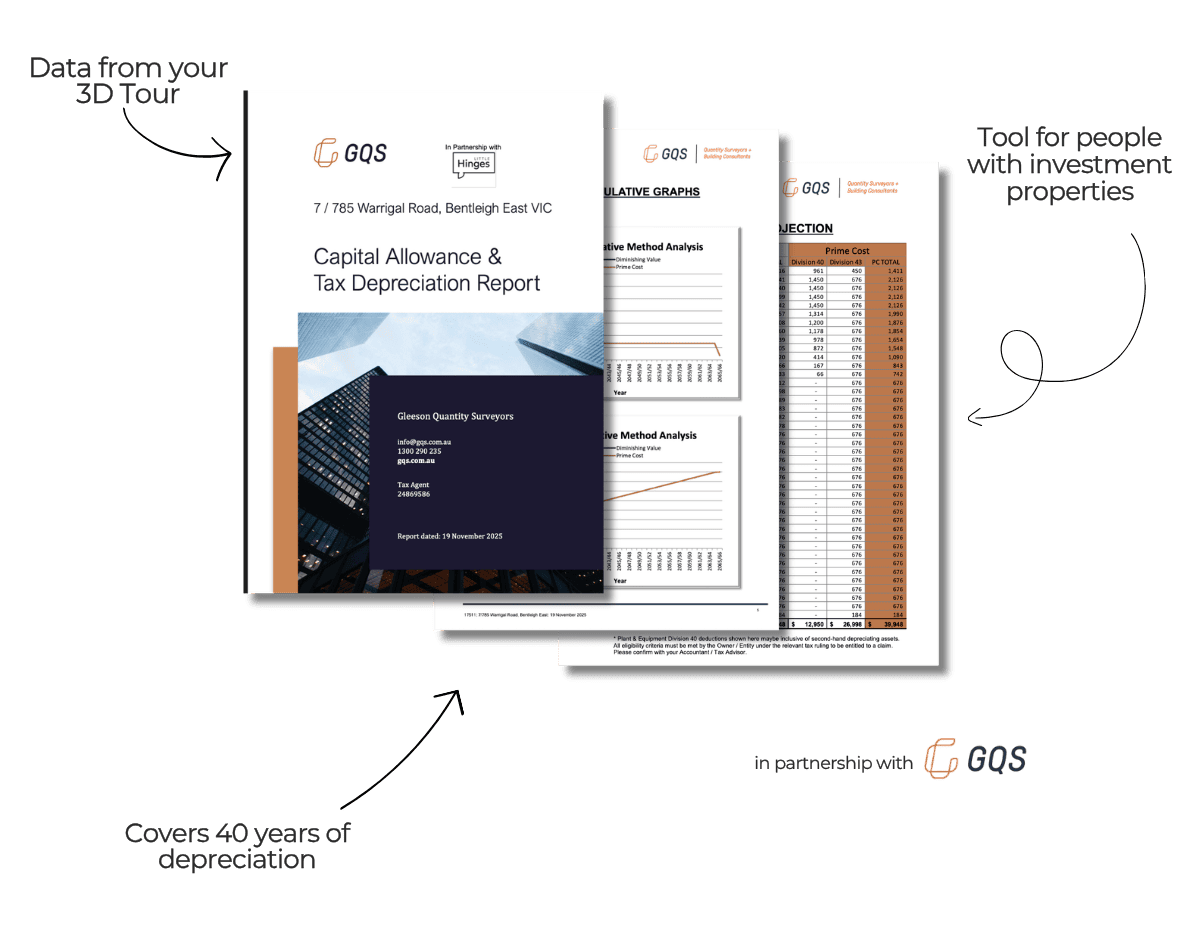
A tax depreciation schedule is a report prepared by a qualified quantity surveyor that sets out how much of your investment property's structure, fixtures and fittings you can claim as a tax deduction each year, for up to 40 years. Your accountant enters the numbers; the ATO accepts them because a registered professional calculated them.
Buildings and their contents wear out. The tax system recognises that as a real cost of holding an income-producing asset, so it lets you deduct a portion of that decline every year, without spending anything. It’s the one deduction most investors never claim, because it needs a survey to substantiate.
One schedule covers the life of the property. You order it once, your accountant uses it every year, and it’s adjusted only when you renovate or improve.
Anyone earning rent from a residential or commercial property. Newer and recently renovated properties claim the most.
Order on behalf of clients and receive a schedule formatted to drop straight into the return. No follow-up questions.
Offer it to landlords as a retention service. We already scan the property for condition records, so the schedule comes from the same visit.
Two categories of deduction, two very different rates. Missing either one is where money is left on the table.
Structural elements and permanent fixtures, generally claimed at 2.5% a year over 40 years from construction.
Removable assets, each with its own effective life. This is where itemising by hand beats an estimate.
Prime cost and diminishing value are both provided, so you and your accountant can choose the profile that suits your position.
Your share of lifts, pool heaters, gym equipment and common area assets: the deductions apartment investors most often miss entirely.
Every year is set out in advance. Your accountant reads the row for this financial year and moves on.
The standard industry process is a desktop assessment: council plans, a few photos from the agent, and an assumption about what's inside. We start with a 3D LiDAR scan of the actual property.
| Compared on | Little Hinges | Typical desktop schedule |
|---|---|---|
| How the property is assessed | 3D LiDAR scan on site | Council plans and photos |
| Measurements | Millimetre accurate | Estimated from drawings |
| Plant and equipment | Itemised from what is there | Assumed from property type |
| Site visit | One, about an hour | Often none |
| What you keep afterwards | A dated 3D record of the property | The PDF |
| Price | $660 fixed | Usually quoted |
One visit of about an hour, at a time the tenant agrees to. Everything after that is done remotely.
The scan is a dated, measured record of the property's condition and contents, useful well beyond the tax return.
If we've captured the property for a listing or a condition report, the schedule is built from that capture.
The average Australian investor claims $2,724 in depreciation every year. On a $660 fixed fee, that's roughly four times the cost recovered in the first return, and again every year after it, without spending another dollar.
Your figure depends on construction date, build cost, renovations and what's inside. Newer properties and recent renovations claim more.
| Year | Division 43 | Total claim |
|---|---|---|
| Year 1 | $3,100 | $8,400 |
| Year 2 | $3,100 | $6,900 |
| Year 3 | $3,100 | $5,800 |
| Year 4 | $3,100 | $5,100 |
| Years 5 to 40 | $3,100 a year | $3,100+ a year |
Illustrative only. Not a projection for any property.
Sometimes the answer is no, and we'd rather say so than sell you a report you can't use.
Second-hand residential plant and equipment bought after 9 May 2017 generally can't be claimed. Division 43 usually still can. That's the part worth checking with us.
Address, purchase date and any renovation details. Two minutes, no quote process.
About an hour on site, tenant-friendly. Already scanned by us? We skip this step.
Registered quantity surveyors itemise Division 43 and Division 40 from the measured record.
Schedule delivered to you and, if you like, straight to your accountant.
This page is general information, not tax advice. Talk to your accountant about your circumstances.
$660 as a fixed fee, per property, including the site visit. There’s no quote process and no variation by property size for standard residential. The fee itself is tax deductible.
Seven business days from the scan. The scan is booked at a time that suits the tenant and takes about an hour.
Yes. That’s the difference. We capture a 3D LiDAR scan on site, so the schedule is built from measurements and visible assets rather than assumptions drawn off council plans.
GQS, our registered quantity surveying partner. A schedule must be prepared by a qualified quantity surveyor to be ATO compliant. Accountants aren’t permitted to estimate construction costs.
Division 43 covers capital works: the structure and permanent fixtures, generally claimed at 2.5% a year over 40 years. Division 40 covers plant and equipment: removable assets like air conditioning, appliances, carpet and blinds, each with its own effective life. Both are itemised in your schedule.
Often yes, because renovations by any previous owner can be claimable even when the original build is not. If we think you won’t recover the fee, we’ll tell you before you order.
Prior-year returns can generally be amended, and depreciation is a common reason to do it. Your accountant can confirm how many years are available in your circumstances.
Two minutes to order, one hour on site, seven business days to the schedule.